
My Unit 2 Assessment Research Paper can be found here:
Unit 2 Research Paper
Name: Daniella McNulty
Student number: 25045083
Course: MA Fine Art: Digital 2025-27
Email address: d.mcnulty0720251@arts.ac.uk
Title: Beyond Surrealism: Leonora Carrington, Curatorial Care and the Future of Artistic Freedom.
Abstract (356 words):
The contemporary art world is experiencing a period of reassessment regarding gender representation in artistic recognition, curatorial leadership and the art market. Although women earn 70% of Bachelor of Fine Arts and 65–75% of Master of Fine Arts degrees in the U.S., this is not reflected proportionately in institutional power, gallery representation or market value (Steinhauer, 2014). Meanwhile, revived attention to women associated with Surrealism, including Frida Kahlo and Leonora Carrington, is challenging established accounts of the movement.
Using Carrington’s Musée du Luxembourg retrospective as its central case study, this thesis examines how cultural narratives and economic structures shape artistic recognition. Drawing on feminist art history, curatorial theory, market data and original correspondence with the Leonora Carrington Estate and international and independent galleries, it explores artistic freedom, visibility and stewardship. Despite rising sales and exhibitions, we can see that persistent inequalities reveal a lagging market reality, whereby visibility is outpacing financial parity. Lasting artistic agency therefore requires curatorial responsibility through action, global support for emerging artists and sustainable infrastructures beyond auction success, particularly amid the uncertainties of winter 2026.
Building the bridge between the past and the future, and rather than presenting Surrealism as a timeless movement, this thesis situates it within its historical and political context while tracing how its pursuit of imaginative freedom continues to inform contemporary practice. If André Breton sought to liberate the unconscious, then Leonora Carrington challenged the roles assigned to women within Surrealism, developing her own mythology, humour and artistic authorship. Her legacy thus raises a question: who creates the conditions in which such freedom can flourish, and who will create these tomorrow?
This thesis argues that curatorial care is not just benevolent intention, but also an accountable practice that questions authority, supports artists over time and makes room for voices that have not yet been recognised. Perspectives from Carrington’s estate and galleries of differing scales illuminate both the possibilities and tensions of this responsibility. Beyond preserving the philosophy of a twentieth-century movement, the task is to sustain the conditions for imaginative freedoms: to care for what has been inherited while making space for what cannot yet be imagined.
5 key words:
Surrealism
Feminism
Curation
Kindness
Freedom
Main body of text (3716 words)
Introduction (283 words)
The history of art is often written through moments of rupture and restitution, yet equally significant are the moments in which history pauses to reassess whose contributions have been recognised and whose have been overlooked. The renewed international attention given to Carrington, culminating in her retrospective at the Musée du Luxembourg and continuing with her recent solo show at Almine Rech, arrives at precisely such a moment. Across museums, galleries and academia, women Surrealists are increasingly recognised not as peripheral figures, but as artists central to the movement’s history. Yet greater visibility does not yet translate into equality. Despite rising auction records and renewed institutional interest, women artists remain disproportionately underrepresented at the highest levels of the art market. This contradiction raises the central question of this thesis: what responsibilities do curators, galleries and cultural institutions hold in sustaining artistic freedom beyond the moment of recognition?
Taking Carrington as its central case study, this thesis examines artistic authorship, recognition and institutional power through feminist art history, curatorial theory, market data and original correspondence with the Leonora Carrington Estate and galleries of differing scales. It explores how auction markets and gallery models determine visibility, investment and sustained support, while distinguishing Surrealism’s historical pursuit of imaginative freedom from its contemporary relevance. It argues for curatorial care that questions cultural value, shares authority and welcomes overlooked voices. As a practicing Artist-Curator, I feel concerned and involved in what the art world has to offer today, and how it will inevitably evolve tomorrow. Through this research, I hope to make a difference to my own artistic practice, as well help to elevate those around me, through the shows I continue to create in the years to come.
Main argument (3089 words)
The recent Art Basel report highlights the renewed recognition of women Surrealists as artists rather than muses (Skeggs, 2026). Tate Modern’s 2026 exhibition ‘Frida: The Making of an Icon’ became its highest pre-selling exhibition, marking a dramatic shift since its 2005 Kahlo exhibition. Carrington shares this cultural and commercial resurgence, yet exceptional success does not signify gender parity. Despite record sales and major retrospectives, women remain underrepresented at the highest levels of the auction market. Are institutions correcting historical inequalities, or merely elevating a select few within unchanged structures through ‘click-baiting’ trends?
This tension is not new. More than a century after Breton’s ‘Manifesto of Surrealism’, this revitalised celebration of women Surrealists invites the onlooker to reconsider the conditions under which they were originally recognised. Despite exhibitions such as the 1986 Venice Biennale’s ‘Arte e Alchimia ’, which featured several women artists now achieving record auction prices, their contributions have long been overshadowed by male counterparts. Carrington herself resisted the position assigned to women within Breton’s Surrealism, famously declaring, ‘I didn't have time to be anyone's muse... I was too busy rebelling against my family and learning to be an artist’ (cited in Chadwick, 1985; Musée du Luxembourg, 2026). Rather than remaining an object of fascination, she developed her own mythology, visual language and imaginative autonomy. Through hybrid creatures, transformations and dream worlds, she created alternative realities in which women could claim power and freedom on their own terms.
Alongside Carrington was Manina, seen as a muse to Erwin Blumenfeld and admired by Breton, who described her work as ‘pure poetry’ (Richard Saltoun Gallery, 2026). Manina also occupied a particular place within Surrealism, contrasting with Breton’s description of Carrington as a ‘witch’ or ‘enchantress with a velvety, mocking gaze’ (Breton, 1997). Another Surrealist artist represented by Richard Saltoun is Toyen, who adopted the masculine form of the Czech language and dressed in men’s clothes. Toyen’s exploration of gender conventions was supported by Breton, Max Ernst, Yves Tanguy and Salvador Dalí. These contrasting positions raise a question: on whose terms could women gain recognition within a movement that sought to overthrow convention?
To a certain extent, Breton’s own language reveals the tension behind this question. A century ago, he could write that ‘this idea, this woman’ disturbed the male mind and that women ‘tend to make [the mind] less severe’. This might partly reflect the gendered structure of French, but his assertion that ‘Man, that inveterate dreamer… knows what women he has had’ (Breton, 1924) leaves little room for a reciprocal female perspective, in this passage. Carrington, however, reclaimed figures such as witches and sorceresses, transforming their negative associations into sources of imaginative power through fables and folklore, making these figures the protagonists of today’s leading exhibitions (Scott, 2017). Women were drawn to Surrealism precisely because the movement challenged convention, even as they encountered its gendered limitations, which – a century ago – they would have experience through a different prism. They engaged with Surrealism ‘not just aesthetically, but as a philosophy’ (Greeves, cited in Scott, 2017). The renewed recognition of these artists, including at the Musée du Luxembourg and Almine Rech in 2026, therefore invites a reassessment not only of their contribution to Surrealism, but of the terms on which that contribution was historically recognised, and how it continues to metamorphose the art world today.
Carrington’s work resonates today through its exploration of identity, trauma, mythology and transformation. Yet her relative financial security and connections with influential figures, including Max Ernst and Edward James, may have afforded her opportunities unavailable to many women artists. Despite these advantages and an early solo exhibition at New York’s Pierre Matisse Gallery, wider institutional recognition arrived much later. This paradox exposes the distinction between artistic independence and cultural recognition: although contemporary institutions are moving towards greater gender parity, progress remains uneven, revealing how financial resources and professional networks continue to shape artistic freedom.
Carrington’s enduring influence reflects a convergence of historical, cultural and institutional forces, rather than an uninterrupted continuation of Surrealism. Amid contemporary economic and political uncertainty, her legacy and personal upbringing raises a compelling question: how might artists without financial security gain the opportunities afforded to those with established connections? Honouring Surrealism requires preserving its spirit of experimentation while recognising its historical specificity. Rooted in Breton’s manifestoes, psychoanalysis and interwar revolutionary ambitions, the movement cannot encompass every contemporary practice concerned with dreams or mythology. Instead, Carrington’s legacy demonstrates how artists can transform Surrealism’s methods into new forms of imaginative agency. The curatorial challenge is therefore not to perpetuate a historical movement, but to extend the artistic freedoms it helped make imaginable for tomorrow.
Central to this shift is the growing influence of women as both artists and curators, as can be seen with these recent major retrospectives in London and Paris. Despite women representing a substantial majority within many contemporary art education programmes, this demographic reality remains unevenly reflected within the commercial art market. Male artists continue to dominate auction results, major collections, and institutional visibility. As the National Museum of Women in the Arts website statistics page illustrates, there are no women in the top 0.03% of the auction market, where 41% of the profit is concentrated. Overall, 96% of artworks sold at auction are by male artists (Bocart, Gertsberg, and Pownall, 2018). An updated version of this statistic shows that women represent just 11% of the top 200 artists, with no women among the top 10 (McAndrew, 2026). Here, the stark reality of the current market shines through, despite the promising Kahlo/Emin/Carrington wave. These statistics show that financial reality has yet to catch up with the cultural recognition of women artists and while their visibility is rising, their market value remains stubbornly unequal. These multimillion-dollar sales do, however, raise a deeper question: do growing sales signal consequential progress for women artists, or do they merely highlight the market's growing appetite for a handful of exceptional names, while the structures that determine artistic recognition and value remain largely unchanged?
Art dealer Richard Saltoun observes that Latin American audiences have historically celebrated their women artists more readily than their European counterparts, suggesting a geographical disparity in how artistic value is recognised (interviewed in Skeggs, 2026). In addition to these geographical and spiritual differences, the evolution around women Surrealists could also be seen as commercial, as the market for their art and exhibitions of their art are flourishing. The expatriated artists who left Europe to join Kahlo in Mexico, such as Remedios Varo, Alice Rahon and Carrington herself, are among the biggest names. In 2024, Carrington’s Les Distractions de Dagobert (1945) sold for USD $28.5 million at Sotheby’s New York, outdoing the artist’s previous auction record of $3.3 million, by $25.2 million. In March, Children’s Games (1942) by Dorothea Tanning sold for GBP £4.7 million at Christie’s London, nearly doubling the previous auction record for Tanning. According to Sotheby’s, annual auction sales of women Surrealist artists grew from USD $7.9 million in 2018 to $94.3 million in 2024, outgrowing the evolution of their male counterparts. Although full gender parity remains elusive, the recent resurgence of women Surrealists marks a significant shift in artistic recognition, one whose lasting impact will depend on understanding what has driven this change and ensuring that its momentum leads to meaningful, sustained progress.
One of the key driving factors behind this change started with a defining moment that happened during the Los Angeles County Museum of Art (LACMA)’s 2012 show ‘In Wonderland’, the first major event featuring women Surrealists working in Mexico and the United States. Specialist Surrealist gallery founder Wendi Norris argues that this exhibition helped to generate a new and even more active group of collectors on an international level (interviewed in Skeggs, 2026). This is one of many examples that demonstrates the power of curation to reshape visibility and artistic legacy. Maintaining this momentum requires sustained exhibitions, acquisitions and scholarship - not simply the temporary rediscovery of historically overlooked women. Curatorial care, therefore, can become an active means of rebalancing art history, not just a passive choice of the best-selling artists of the current trend wave.
Wider social change has also accelerated this reassessment. Art historian Alyce Mahon argues that the #MeToo movement played a major role in putting pressure on institutions to reassess gender parity (interviewed in Skeggs, 2026). The current emergence of women Surrealists can therefore be understood as a rediscovery – as they did not already have major visibility once in the past – and as a correction of how Surrealism has historically been presented, to a certain degree. Maintaining this momentum means ensuring that greater female representation becomes accepted and embedded within institutional practice, rather than remaining a temporary trend in response to pressure, or the need for change. That gender parity goes beyond becoming a norm, but a necessity upon which a new, true model of diversity and inclusivity, could be built in the near future. Despite these positive changes, the reality of the art world is still weighed down by heavy, objective figures. Data from 2025 The Art Basel and UBS Art Market Report by Clare McAndrew of Arts Economics found that women only represent 11% of the top 200 artists at auction, and just 8% of the value. Even with the record Kahlo sale, the share of value for women was still down compared to 2024.
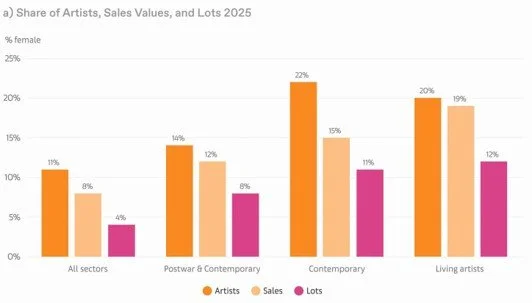
Figure 1. Share of Artists, Sales Values, and Lots 2025. The Art Basel and UBS Global Art Market Report 2026.
The glaring truth is that gender parity might not arrive in the auction market until 2053, at the current rate of growth (Burns and Halperin, 2022). What would Carrington say, seeing the modern-day woman artist still struggling for recognition, so long after her own revolution against the assumed status of women artists to be Muses for men? To make change: How can we act on ‘the phallocentrically structured symbolic order’ by promoting a ‘politico-aesthetic project of representing “feminine difference”' today? (Watz, 2022). This responsibility falls into the hands of the directors of institutions and galleries, curators, but also – as times change, social media grows, and as the younger generations evolve and demolish aeons-old rules with sophisticated, digital sledgehammers – into the hands of the artists themselves, and their communities. Particularly significant is this concept of the artist-curator.
Traditionally, artistic production and curatorial practice have been understood as distinct activities. However, contemporary practitioners increasingly operate across multiple roles: artist-curator, curator-gallerist, educator-curator, activist-curator, and cultural producer. These hybrid positions challenge conventional hierarchies and suggest new forms of cultural value creation, just as Carrington’s creations challenged Surrealism.
The etymology of the word curator derives from the Latin curare - to care. Historically, curators cared for objects, collections, and cultural heritage. Today, however, curation increasingly extends towards caring for artists, audiences, communities, narratives, and relationships. This shift is especially relevant within discussions surrounding women’s leadership in the arts. Many female cultural leaders emphasise mentorship, collaboration, relationship-building, and long-term stewardship alongside exhibition-making itself. Their work often demonstrates that cultural value emerges not only through the presentation of artworks but through the creation of supportive ecosystems that enable artistic practices to flourish.
Curatorial care also intersects with Surrealism’s capacity to transform trauma into creative possibility. Historically, women have faced social, physical and psychological restrictions that shaped their artistic expression. Carrington’s institutionalisation in Santander, recounted in ‘Down Below’, exemplifies the tension between lived trauma and imaginative autonomy. Rather than merely documenting oppression, her work transforms experiences of constraint into expressions of agency, resistance and hope.
Through hybrid creatures, shifting identities and dreamlike worlds, Carrington challenges fixed boundaries between reality and imagination. Contemporary artists continue to explore these possibilities through symbolism, fragmentation and mythology. Yet perhaps the greatest contemporary Surrealist paradox lies within the art market itself: while art derives much of its significance from emotion, meaning and human connection, increasingly financialised structures can privilege speculation, exclusivity and visibility over artistic experimentation and freedom.
This is not an argument against galleries. Institutions such as Hauser & Wirth, Galerie Mennour and others continue to play essential roles in supporting artists and shaping cultural discourse. However, recent discussions surrounding the sustainability of the gallery model suggest a growing need to reconsider how these ecosystems operate. Rather than endless expansion, future success may depend upon depth, loyalty, patience, and community-building. As Eva Presenhuber notes, ‘good art always eventually finds a way to persevere’ (cited in Mennour, 2026). Similarly, Iwan Wirth argues that ‘today, more than ever, our role is not about shouting louder. It is about making the artworld legible’ (cited in Mennour, 2026). Kamel Mennour himself states that ‘the biggest challenge [he sees] for galleries is preserving depth and artistic integrity in a culture driven by speed and constant visibility’ (Mennour, 2026).
The responsibilities of curatorial care become particularly visible when comparing galleries operating at different scales. In original correspondence conducted for this thesis, Guillaume Lointier, Senior Director of Almine Rech Paris, was asked what an international gallery must care for today and tomorrow, following its first solo exhibition of Carrington. His response identified four interconnected responsibilities: protecting artists’ freedom over time, preserving the histories and provenance of their work through careful curation, connecting galleries with estates, scholars and public institutions, and supporting artists and audiences who remain outside dominant cultural narratives (Lointier, 2026).
Particularly significant is Lointier’s distinction between lasting recognition and passing fashion. Carrington’s commercial and institutional resurgence may represent a long-overdue correction of the Surrealist canon, yet its value cannot be measured by exhibitions or sales alone. Without sustained research, meaningful collaboration and a willingness to support less established artists, renewed visibility risks becoming another market trend rather than structural progress. Lointier’s emphasis on caring for ‘what cannot yet be seen’ offers a more demanding definition of curatorial responsibility: preserving artists whose importance has already been recognised, and creating opportunities for those whose work has yet to receive the same level of attention - a balance between strong and safe.
A complementary perspective emerges from original correspondence with Paula Forteza, founder of Artivistas Gallery in Paris, which specialises in Latin American art. Forteza describes a younger generation engaging with Carrington through reading, writing, workshops and their own artistic practices, suggesting that her influence now extends beyond historical recognition into contemporary creative production (Forteza, 2026). Her description of Carrington as ‘a playful ghost amongst us’ captures something that auction figures cannot: the continuing imaginative presence of an artist whose work inspires others to create all over the world, today. This professional perspective brings Carrington’s journey full circle: from a Europe that struggled to recognise her artistic independence, through Mexico where her vision flourished, to a twenty-first-century Europe gradually reassessing her legacy through Saltoun, and, with it, the place of women artists within the Surrealist canon.
Together, these perspectives reveal complementary dimensions of care: Lointier emphasises institutional responsibility, while Forteza highlights the communities that keep legacies alive. Yet care must be judged by its consequences, not its intentions. Institutions may champion artistic freedom while controlling whose work receives recognition. Meaningful curatorial care therefore demands accountability, shared authority and the courage to take risks. Carrington’s legacy becomes truly transformative when her belated recognition opens doors for artists whose voices remain unheard.
The gallery of the future may therefore be defined less by scale than by care. It may prioritise long-term relationships over rapid growth, artistic development over speculation, and meaningful engagement over constant visibility. It may create memorable experiences, unexpected encounters, and spaces for genuine participation. In this sense, future galleries may become closer to contemporary expressions of Surrealist thinking: places where surprise, experimentation, chance, and imagination remain possible. A dream-reality where gender parity is finally the norm, and were opening nights go beyond the obvious, creating new core memories through strategies of hybridisation and cultural collaborations bridging industries, castes and generations.
Yet timing remains crucial. At a moment when the art world is reassessing whose voices deserve recognition, the future of artistic freedom may depend on a more courageous form of curatorial care, grounded in radical kindness. This would mean moving beyond the predictable balance of established and emerging artists, to potentially including an odd, unexpected artist, every now and then, whose work may not yet fit prevailing tastes, market expectations or institutional narratives. Such an approach would embrace risk not as a commercial strategy, but as an ethical commitment to making room for what cannot yet be recognised or imagined. This is something that was seen at Art Basel this year, had the safety of the fair not been comprised by security threats, and this is something that was also seen elsewhere in Paris, at - for example – at AKAA, Offscreen, et al.
Ultimately, the future of artistic freedom no longer lies in reproducing the dreams of the twentieth century. It lies in creating new forms of freedom for the twenty-first. Carrington’s legacy demonstrates that imagination remains a powerful tool for challenging limitations and envisioning alternative realities. In an era increasingly defined by uncertainty, acceleration, and structural change, her work serves as a reminder that creativity thrives through risk, chance, error, and possibility. If the curator’s role is to care, and the artist’s role is to imagine, then the next era of a certain ‘Neo-Surrealism’ may emerge precisely where those two responsibilities meet.
Carrington’s revival coincides with a wider reassessment of artistic power, as women increasingly reshape cultural narratives through care, collaboration and creative freedom. The timing is far from accidental. Yet this progress unfolds amid renewed misogyny, extremism and political unrest. As war and economic uncertainty challenge the art world and its neighbouring industries, art remains a vital space where dreams can transcend commercial value, resist oppression and inspire a better future.
What, then, does Carrington’s legacy mean for the future of artistic freedom? Curatorial care must extend beyond good intentions to challenge institutional power, protect artistic autonomy and recognise, as Lointier suggests, ‘what cannot yet be seen’. Where Breton sought liberation through the unconscious, Carrington forged her own mythology of imagination, humour and resistance. In original correspondence for this thesis, Daniel Weisz Argomedo, Carrington’s grandson and representative of her estate, expressed the hope that future generations would discover ‘a path to freedom in every possible conceptualization of that word’ (Weisz Argomedo, 2026). His words extend Carrington’s legacy into a future of artistic freedom which each generation must discover for itself. The challenge for curators is therefore not simply to preserve artistic legacies, but to create the conditions in which new imaginations can flourish, finally bringing down the glass ceiling for emerging artists, side-by-side on the walls of galleries, with their famous international counterparts.
Conclusion (344 words)
The renewed recognition of women Surrealists exposes a persistent contradiction: cultural visibility is advancing faster than economic equality. Carrington and Kahlo's extraordinary success signals the beginning of a correction of art history, yet the triumph of a few cannot be mistaken for gender parity. True artistic freedom is ultimately a question of agency: the freedom to create, choose, refuse and define one's own identity, supported by the financial and institutional conditions that make such independence possible. A fact remains; The majority of women artists do not benefit from these record auction prices, and arguably many artists regardless of gender do not benefit from any record auction prices at all, but the current focus of this thesis around women artists could perhaps be addressed, in part, with a clearer global action plan set in stone around curatorial responsibility.
Curatorial care must become action. Radical kindness is not sentimentality, but the courage to challenge established hierarchies, share cultural power and recognise artistic value before the market does. The inclusion of a ‘wild card’ odd, unexpected artist in group exhibitions could offer one practical experiment, although its lasting impact would require further research beyond the market statistics and professional perspectives examined here.
Yet good curation offers something that statistics cannot measure. At its most extraordinary, an exhibition becomes a portal into another world: a place where dreams acquire form, unexpected encounters create possibilities, and imagination becomes contagious. Such experiences inspire artists to create more courageously, to open doors for others, and perhaps to inspire another generation to do the same. The cycle of imagination, care and creation has no necessary endpoint.
Beyond Surrealism, Carrington's legacy is not simply about correcting the past, but about expanding the possibilities of the future. Artistic freedom begins with the right to imagine, but flourishes through the agency to act upon that imagination. To curate is therefore not merely to preserve what has been inherited, but to create the conditions for what cannot yet be imagined, ensuring that future generations have the freedom to dream beyond the limits of our own imagination.
‘Beloved imagination, what I most like in you is your unsparing quality’ (Breton, 1924).
‘Beloved kindness, what I most like in you is your misunderstood strength’ (McNulty, 2026).
Bibliography/reference list
Aberth, S.L. (2004) Leonora Carrington: Surrealism, Alchemy and Art. Aldershot: Lund Humphries.
Bocart, F., Gertsberg, M. and Pownall, R.A.J. (2018) Glass Ceilings in the Art Market. SSRN Electronic Journal. Available at: SSRN https://papers.ssrn.com/sol3/Papers.cfm?abstract_id=3079017 (Accessed: 3 August 2026).
Boni, V. (2026) The Symptomatic Surreal: Leonora Carrington. Exhibition catalogue. London: Freud Museum London.
Breton, A. (1924/1972) Manifestoes of Surrealism. Translated by R. Seaver and H.R. Lane. Ann Arbor: University of Michigan Press. – Translated from the original French version - Breton, A. (1924) Manifeste du surréalisme. Paris: Éditions du Sagittaire.
Breton, A. (1930/1972) ‘Second Manifesto of Surrealism’, in Manifestoes of Surrealism. Translated by R. Seaver and H.R. Lane. Ann Arbor: University of Michigan Press, pp. 117–194. – Translated from the original French version - Breton, A. (1930) Second manifeste du surréalisme. Paris: Éditions Kra.
Breton, A. (1997) Anthology of Black Humor. Translated by M. Polizzotti. San Francisco: City Lights Books.
Burns, C. (2026) As Pace Gallery cuts artists and staff, the mega-gallery model looks shaky. Financial Times, 11 June. Available at: https://www.ft.com/content/5c661326-0e44-4f74-a63c-40a474fbf923 (Accessed: 11 June 2026).
Carrington, L. (1988) The House of Fear: Notes from Down Below. London: Virago Press.
Carrington, L. (2005) The Hearing Trumpet. Introduction by A. Smith. London: Penguin Books.
Chadwick, W. (1985/2021) Women Artists and the Surrealist Movement. Revised edition. London: Thames & Hudson. Quoted on the wall by Musée du Luxembourg, Paris, 2026 (exposition co-organisée par le GrandPalaisRmn et Mondo Mostre, COMMISSARIAT - Tere Arcq et Carlos Martín).
Countess.Report (2019) Edited by A. Prcevich. Melbourne: Countess.Report. Available at: Countess.Report – 2019 Countess Report https://countess.report/2019-Countess-Report (Accessed: 3 August 2026).
Embleton, P. (2026) The Model Was Always Broken. The Art of Installation, 9 June. Available at: https://theartofinstallation.substack.com/p/the-model-was-always-broken (Accessed: 11 June 2026).
Freud, S. (1917) Introductory Lectures on Psychoanalysis. London: George Allen & Unwin.
Goldstein, A. (2019) ‘What Will the Art Gallery of the Future Do? Pace’s Marc Glimcher on the Coming Disruption and Why the “Art World Is Not Fair”’. Artnet News, 5 March. Available at: https://news.artnet.com/market/marc-glimcher-interview-1480423 (Accessed: 14 August 2026).
Hessel, K. (2022) The Story of Art Without Men. London: Hutchinson Heinemann.
K-ARTNOW (2026) The Crisis of the Mega-Gallery Model: From an Era of Expansion to Structural Reassessment. K-ARTNOW, 9 June. Available at: https://k-artnow.com/posts.php?co_id=1780981304 (Accessed: 11 June 2026).
McAndrew, C. (2026) The Art Basel and UBS Art Market Report 2026. Arts Economics. Available at: https://theartmarket.artbasel.com/download/The-Art-Basel-and-UBS-Art-Market-Report-2026-by-Arts-Economics.pdf (Accessed: 29 September 2026).
Mennour (2026) [Ahead of Basel Exclusive, 5 gallery founders share how they are reinventing the art trade and adapting to a changing landscape.] Instagram, 8 June 2026. Available at: https://www.instagram.com/p/DZVEj37CFwQ/ (Accessed: 10 August 2026).
National Endowment for the Arts (2019) Artists and Other Cultural Workers: A Statistical Portrait. Washington, DC: National Endowment for the Arts. Available at: National Endowment for the Arts https://www.arts.gov/impact/research/publications/artists-and-other-cultural-workers-statistical-portrait (Accessed: 3 August 2026).
National Museum of Women in the Arts (n.d.) Get the Facts About Women in the Arts. Available at: National Museum of Women in the Arts – Get the Facts About Women in the Arts https://nmwa.org/support/advocacy/get-facts/ (Accessed: 11 July 2026).
Richard Saltoun Gallery (2026) Art Basel: Booth D13 | Manina. Available at: https://www.richardsaltoun.com/art-fairs/285-art-basel-booth-d13-manina/overview/ (Accessed: 13 August 2026).
Richard Saltoun Gallery (2026) Scandalous: Women in Surrealism. Exhibition, 12 May–2 July 2026, New York. Available at: Richard Saltoun Gallery – Scandalous: Women in Surrealism https://www.richardsaltoun.com/exhibitions/158-scandalous-women-in-surrealism/ (Accessed: 2 August 2026).
Scott, I. (2017) ‘The Pivotal Role That Women Have Played in Surrealism’. Artsy, 4 July. Updated 21 December 2018. Available at: Artsy https://www.artsy.net/article/artsy-editorial-women-surrealism-muses-masters (Accessed: 3 August 2026).
Skeggs, T. (2026) Art Market Report: As Fridamania grips London, female Surrealists' market surges. Art Basel Stories, 29 June. Available at: Art Basel Stories - https://www.artbasel.com/stories/art-market-report-london-female-surrealists-frida-kahlo (Accessed: 1 August 2026).
Steinhauer, J. (2014) ‘Tallying Art World Inequality, One Gallery at a Time’. Hyperallergic, 27 March. Available at: Hyperallergic https://hyperallergic.com/tallying-art-world-inequality-one-gallery-at-a-time/ (Accessed: 3 August 2026).
Sullivan, E.J. (ed.) (2023) Leonora Carrington: Dream Weaver. New York: DelMonico Books.
Watz, A. (2022) Surrealism and Feminine Difference. Research project funded by Riksbankens Jubileumsfond. Available at: Riksbankens Jubileumsfond https://www.rj.se/en/grants/2022/surrealism-and-feminine-difference/ (Accessed: 3 August 2026).
Appendix of full interview quotes
Lointier, G. (2026) ‘Email correspondence with the author regarding curatorial care and the Leonora Carrington exhibition at Almine Rech’, 25 September 2026. Unpublished personal communication. Guillaume Lointier, Senior Director and Paris Gallery Director, Almine Rech.
‘I would say that care operates on several levels at once. First, care for artists, and for their time. Carrington's trajectory is a lesson in this respect: she worked for more than six decades, largely in Mexico, with a freedom that owed little to the market or to the official narratives of Surrealism. Caring for an artist means protecting that freedom, accompanying a body of work over the long term, and resisting the pressure to reduce it to a few recognisable images.
Second, care for the works and for their histories. Exhibiting Carrington today involves rigorous research, attention to provenance, and close dialogue with the estate, with scholars and with institutions. The current rediscovery of women Surrealists is only meaningful if it rests on this kind of scholarly care. Otherwise it risks becoming a new form of fashion rather than a lasting correction of the canon.
Third, care for the ecosystem. A gallery's work does not stand alone. It sits alongside museum retrospectives such as the one at the Musée du Luxembourg, loans to public institutions, and publications. Our role is to connect these spheres, which means sharing knowledge and making works accessible, not only selling them.
And tomorrow? I believe we will have to care for what cannot yet be seen: the artists who, like Carrington in her time, are working on the margins of dominant narratives, and the audiences who do not yet walk through our doors. Many of Carrington's works speak of transformation, of hybrid beings and of the porous boundary between the human and the living world. That may be the deepest form of care a gallery can offer: making room for ways of seeing that the present has not yet learned to value.’
Forteza, P. (2026) ‘Correspondence with the author regarding Leonora Carrington's influence on contemporary artists’, [24 September 2026]. Unpublished personal communication. Paula Forteza, founder, Artivistas Gallery, Paris.
‘I manage a Latin American art gallery in Paris and I see young artists getting inspired by Leonora Carrington every day. They read about her, write about her, organize workshops about her, try to honour her through their work. Leonora Carrington is finally having the attention she lacked during her life, making her as influential as a living contemporary artist. A playful ghost amongst us, like the ones she liked to paint.’
Weisz Argomedo, D. (2026) Email correspondence with the author regarding Leonora Carrington's legacy, 6 August 2026. Unpublished personal communication between Daniel Weisz Argomedo and Daniella McNulty. Daniel Weisz Argomedo is Leonora Carrington's grandson and representative of the Leonora Carrington Estate.
‘I hope they discover worlds in which they can harness their own imagination. The wonderful humor that she possessed that is present in her work. Most importantly I hope they see a path to freedom in every possible conceptualization of that word.’ (Weisz Argomedo, 2026)
For more context on my primary source quotes:
There was something that I had to do for my Research Paper that I would like to highlight in this separate blog post, as it was a first for me in many ways, and yet came from habits and skills that I already developed over the last 15 years in Marketing, Communications, PR, and Events. The first quote I got was from the grandson of Leonora Carrington himself, Daniel Weisz Argomedo. When he replied to my email with this quote, I literally howled with delight, because it meant that my intuition and choice of direction had been - in some ways - confirmed:
Weisz Argomedo, D. (2026) Email correspondence with the author regarding Leonora Carrington's legacy, 6 August 2026. Unpublished personal communication between Daniel Weisz Argomedo and Daniella McNulty. Daniel Weisz Argomedo is Leonora Carrington's grandson and representative of the Leonora Carrington Estate.
The question that I asked was What do you hope future generations of artists, curators and writers will continue to discover in Leonora Carrington's work?
‘I hope they discover worlds in which they can harness their own imagination. The wonderful humor that she possessed that is present in her work. Most importantly I hope they see a path to freedom in every possible conceptualization of that word.’ (Weisz Argomedo, 2026)
+
To make things even better, I then received a reply from Guillaume of Almine Rech, which gave my paper even more street cred from a gallery point of view, as this was quite literally the very gallery that had chosen to show Leonora Carrington’s work in her first ever solo retrospective, just after the success of the Musée du Luxembourg exhibition:
Lointier, G. (2026) ‘Email correspondence with the author regarding curatorial care and the Leonora Carrington exhibition at Almine Rech’, 25 September 2026. Unpublished personal communication. Guillaume Lointier, Senior Director and Paris Gallery Director, Almine Rech.
The question that I asked was: If the original meaning of “curator” is “to care”, what do you believe a major international gallery group like Almine Rech must care for today, and tomorrow?
‘I would say that care operates on several levels at once. First, care for artists, and for their time. Carrington's trajectory is a lesson in this respect: she worked for more than six decades, largely in Mexico, with a freedom that owed little to the market or to the official narratives of Surrealism. Caring for an artist means protecting that freedom, accompanying a body of work over the long term, and resisting the pressure to reduce it to a few recognisable images.
Second, care for the works and for their histories. Exhibiting Carrington today involves rigorous research, attention to provenance, and close dialogue with the estate, with scholars and with institutions. The current rediscovery of women Surrealists is only meaningful if it rests on this kind of scholarly care. Otherwise it risks becoming a new form of fashion rather than a lasting correction of the canon.
Third, care for the ecosystem. A gallery's work does not stand alone. It sits alongside museum retrospectives such as the one at the Musée du Luxembourg, loans to public institutions, and publications. Our role is to connect these spheres, which means sharing knowledge and making works accessible, not only selling them.
And tomorrow? I believe we will have to care for what cannot yet be seen: the artists who, like Carrington in her time, are working on the margins of dominant narratives, and the audiences who do not yet walk through our doors. Many of Carrington's works speak of transformation, of hybrid beings and of the porous boundary between the human and the living world. That may be the deepest form of care a gallery can offer: making room for ways of seeing that the present has not yet learned to value.’
+
Then, adding a touch of spice, and emerging gallery and artist relevance, Paula also agreed to give a quote, which was just fantastic. I am so happy to feature her, seeing as we have worked together so many times on my exhibitions (Lovechild in 2024 and In Her Room in 2026), as well as our current lifedrawing sessions that are going so well. This quote added even more street cred to my paper, as it gave the 3D depth to the two previous major-institution perspectives:
Forteza, P. (2026) ‘Correspondence with the author regarding Leonora Carrington's influence on contemporary artists’, [24 September 2026]. Unpublished personal communication. Paula Forteza, founder, Artivistas Gallery, Paris.
For Paula; I left the question about Leonora Carrington open, and her answer was perfectly aligned with my hopes for a ‘fun’ last quote:
‘I manage a Latin American art gallery in Paris and I see young artists getting inspired by Leonora Carrington every day. They read about her, write about her, organize workshops about her, try to honour her through their work. Leonora Carrington is finally having the attention she lacked during her life, making her as influential as a living contemporary artist. A playful ghost amongst us, like the ones she liked to paint.’
+
All-in-all, I am very grateful, and hope that these quotes are appreciated as much as they mean to me, but also to the next generation, and what they mean for the future of Art.
+
-
What was the best thing I did? Level up since Unit 1 by questioning my art practice, my daily life, and very my existence on Earth.
Why was this the best thing I did? Because it really feels like the right moment and the safe space within which to do this.
How do I know that this was the best thing I did? Just like Unit 1, there was no other way I saw this experience at Central Saint Martins going. The clarity brought by the Research Paper - combined with the clarity that my art practice goes beyond create artworks but also art opportunities, art moments, art collaborations, and all sorts of things that go beyond the canvas - is lighting the way towards Unit 3, and towards my future in art.
What am I going to do next in response? Find even more answers in the deepest part of the deep end into which I continue to dive.
What worked least well for me? Time management - i am doing too many things at once, and despite how much I love to be busy, it also prevents me from truly being able to update this blog as I would like - regularly bit by bit, as opposed to in big chunks when I finally find the time after having put out all of my other fires.
Why did this not work well for me? Technically all is well - I am getting things done - but it would be less stressful if I could do a little bit every day, rather than let things build up.
What have I learned about the topic concerned from this not having worked well for me? Just as with Olympic training, I think that consistency and habit are so important, and I would love to install a blog-buildling daily habit deep into my mind, just as I do when I jot down my dreams as soon as I wake up, or just as I do when I walk up stairs instead of take the lift or escalator, or even when I feed Trinity half-asleep in the morning and I haven’t even fed myself yet. I deeply desire this consistency in my art practice, and I know I get get there, as I am now realising and accepting that creating art events is just as important to me as creating art pieces, they all feed into each other, just as my consultancy and teaching work feed into my art, by literally financing it.
What have I learned about myself from this not having worked well for me? That I do indeed pile too many things on top of each other, as both my therapist and psychiatrist have said, but as I mentioned - this is very much being dealt with, and I am technically getting things done!
What do I plan to do differently in future as a result of my answers to the above questions? Tick off all of the urgent and important matters before the end of the year, and try my best to start 2027 with a clean slate, and hold back from piling into this peaceful blank page, therefore allowing myself time to daydream, to get bored, to read, to doodle, to wander, to draw, to experiment, to play with metal and woodwork and get involved in more workshops, and to generally create more art.
With hindsight, how would I go about this activity differently if doing it again from scratch? Everything is going well so far! I would just refocus energy into art and making money to support art, and think about everything as a flow from one side to the other, just as Christian told us during class with Jonathan.
To what extent will this activity influence the way I tackle anything similar in future? I echo what was said in Unit 1 - “in every way possible - looking forward to long-lasting positive change!”
What did I find the greatest challenge in doing this work? Actually, getting myself to sit down and create art. Everything else AROUND art seems to come to me much easier!
Why was this a challenge to me? Now it is less a question of making decisions and more a question of creating more time, as it is becoming clearer to me that I like to create opportunities for other artists, so I no longer need to decide between which parts of my Swiss Army Knife are “correct” and move more towards a decision-making process of which knife to use at which moment, all of which are the different parts of Daniella, the Artist.
To what extent do I feel I have met this challenge? While I was previously questioning which subjects to cover in my art (to quote Unit 1 - |feminism? time & space? duality? gender? identity? anatomy? mythology?”), now I know that all of these subjects interest me in my Neo-Surrealist endeavours, and whichever new movement I might want to create one day, but now, the extent to which I feel I have met this challenge comes down to self-acceptation, motivation, and running a self-directed programme of learning, every day.
What can I do to improve my performance when next meeting this particular sort of challenge? Take notes, analyse each situation as a learning opportunity for my art practice, and now move into a pace of work where I am willingly letting each activity flow into the other, as they all feed into my art practice, as the central focal point of my life.
What was the most boring or tedious part of doing this particular task for me? Definitely trying to create routine. I am getting there.
Can I see the point of doing these things? Yes. I can already see how much clearer Unit 2 has made my thought process vs Unit 1.
If not, how could the activity be changed to be more stimulating and interesting for me? More art. MORE. ART.
-
My Unit 2 Research Paper is a subject that intrigues me, fascinates me, runs around in my head from dawn ‘til dusk, and encourages me to be a better artist every day.
Spending the last few months researching this subject has allowed me to open my mind to so many new possibilities, and the path is getting clearer - again - every day. The universe is sending signals.
In order to compare the beginning of my quest to the final frontier of the Learning Outcomes and Research Paper at the bottom of this page, here is the full journey (please click on each title for more details):
-
I am intrigued by how it is still possible to wage war against each other, when we all share the same planet?
I am intrigued by how art could help to shape a more equal future between women, men and all genders?
What is the role of art galleries in the discovery of emerging artists in 2026, versus curators, agents, and brand collaborations?
What is surrealism today, and what is the role of women in a modern day surrealism?
How does past trauma affect future art? Lotus feet, corsets, traps, cages, other limitations for women, artists, et al
How does being pulled in several different directions at the same time help artists to pull forward?
Chicken & the egg - To show or not to show? Make art, make art shows?
I am intrigued by how mood affects creativity, and how creativity affects mood
Love the anti-grading example! How could I treat the Research Paper in a different way, like the nonsense → sausage recipe Research Paper?
I am still intrigued by what I was intrigued by at the University of Warwick - What is love? What is Eros? What is beauty? Is there absolute, objective beauty? “Beauty is truth, truth beauty,—that is all. Ye know on earth, and all ye need to know.” - Keats’ Ode to a Grecian Urn.
-
Strategic Value - As Artist-Curator, Curator-Gallerist Interview, Hauser & Wirth - Jacqueline, and what is the role of women in balancing the genders in the real world %% 80/20 ? Interviews are not to be the same as them, but to define where I fit in the gaps - Etymology of Curator = Care = Taking care of the objects. Different types of curators → Creator? etc
Strategic Value - As Artist - What is surrealism in the 21st century, and what is the role of women in modern day surrealism? Could link → How does past trauma affect future art? Lotus feet, corsets. Leonora Carrington. Freedom, free association, why not?
Subject of interest - Nonsense & Ideas of Love
Subject of interest - Binaries - Us vs Them
Calligraphy, freedom, brush strokes, just flowing, just having fun
-
What is the role of the artist-curator in shaping contemporary surrealism, and how are women artists redefining freedom, care, and identity through trauma-informed artistic practice?
What is the role of women in 21st-century surrealism, and how do contemporary artists transform historical and personal trauma into new forms of freedom, identity, and imagination?
How does contemporary surrealist art use the transformation of trauma, gendered history, and irrationality to challenge social binaries and imagine new forms of freedom?
-
Strategic Value - As Artist-Curator, Curator-Gallerist Interview (Hauser & Wirth - Jacqueline Moore) and Artist-Curators (like Louise te Poele) and what is the role of women in balancing the genders in the real world %% 80/20 ? Interviews are not to be the same as them, but to define where I fit in the gaps - Etymology of Curator = Care = Taking care of the objects. Different types of curators → Creator? etc
Strategic Value Research Paper Proposal
Defining the Artist-Curator: Gender, Care, and Value Creation in Contemporary Art Ecosystems
This research project investigates the evolving role of the artist-curator within contemporary art ecosystems through a series of interviews with artist-curators, curators, gallery directors, and gallerists operating across the international art world. Through conversations with approximately 10–20 professionals—including figures such as Jacqueline Moore of Hauser & Wirth and other leaders working at the intersection of artistic production, exhibition-making, and cultural management—the project seeks to identify emerging models of practice and uncover opportunities for future practitioners working between disciplines.
The central objective of this research is not to emulate existing career trajectories, but rather to understand where new forms of practice can emerge. As an artist-curator who has already independently conceived and delivered exhibitions and cultural projects with organisations including the British Embassy in Paris, NHS London, Groupe Clarins, Ne Pas Toucher, and Dykonic, I am interested in examining the spaces that remain unoccupied within the current cultural landscape. By understanding how established professionals define their roles, create value, and navigate institutional structures, this research aims to identify the gaps where future artist-curators may contribute most meaningfully.
A key focus of the project concerns gender representation and power structures within the art world. Numerous studies have shown that women constitute the majority of students in art education programmes, often representing approximately 70–80% of enrolment across many fine art and creative disciplines. Yet this demographic dominance is not reflected within the commercial art market. Male artists continue to receive higher levels of representation from major galleries, command significantly larger sales figures, and remain disproportionately represented in museum collections and major exhibitions. If the 70/30 rule in art is traditionally seen as a foundational composition principle stating that 70% of an artwork should be dominated by a unifying element, while the remaining 30% should consist of contrasting accents, I would like to look at the ratio of genders in this way, and the way that the reality post-graduation does not reflect the gender ratio during class - at all.
This apparent contradiction raises important questions. If women constitute the majority of those entering artistic education, why does the distribution of visibility, financial value, and institutional recognition remain skewed towards men? What structural barriers continue to shape professional outcomes after graduation? How do women working as curators, gallery directors, collectors, and cultural leaders negotiate these systems? Furthermore, can artist-curators play a role in rebalancing representation and creating alternative models of cultural value?
Rather than framing this investigation solely through the lens of inequality, the research seeks to understand the specific contributions women make to cultural ecosystems. Women increasingly occupy influential positions as curators, museum directors, cultural producers, and arts administrators. Their roles often extend beyond selection and presentation towards relationship-building, community development, mentorship, and long-term care of artistic practices. These forms of labour are frequently less visible than the production of artworks themselves, yet they are fundamental to sustaining cultural infrastructures.
This leads to a second strand of inquiry: the concept of care within curatorial practice.
The word "curator" derives from the Latin curare, meaning "to care for." Historically, the curator's role was centred upon stewardship: the preservation, interpretation, and protection of objects. However, contemporary curatorial practice has expanded far beyond the management of collections. Today, curators often care not only for objects but also for artists, audiences, communities, narratives, and social relationships.
This shift raises an important question: what does it mean to care in contemporary art?
Care may involve protecting cultural memory, supporting emerging artists, creating spaces for difficult conversations, or facilitating encounters between people and ideas. In this sense, curation becomes an active social practice rather than a purely administrative one. The curator is not merely a selector of objects but a mediator of meaning and relationships.
The interviews conducted for this research will explore how different practitioners understand this responsibility. Participants will be invited to reflect on their definitions of curation, value creation, leadership, and care. Particular attention will be paid to the ways in which personal histories, experiences, and challenges shape professional approaches.
A further objective of the project is to examine the expanding spectrum of curatorial identities. Contemporary practitioners increasingly move fluidly between multiple roles: artist-curator, curator-gallerist, curator-producer, collector-curator, educator-curator, and activist-curator. These hybrid positions challenge traditional distinctions between artistic creation and cultural mediation.
One possible outcome of the research is the development of a broader typology of curatorial practice. Such a framework may include questions such as:
Is the curator fundamentally a caretaker?
Is the curator a creator of contexts rather than objects?
Is the curator a connector between people and ideas?
Is the curator an advocate?
Is the curator a lover of culture and community?
Is the curator a translator between worlds?
Can the curator transform personal experiences of trauma into collective forms of empowerment?
These questions move beyond conventional definitions of exhibition-making and address the emotional, social, and political dimensions of cultural work.
Particularly relevant is the relationship between lived experience and curatorial methodology. Many contemporary practitioners draw upon personal histories, identities, and experiences of exclusion in developing exhibitions and cultural programmes. Trauma, marginalisation, and adversity can become sources of insight, empathy, and innovation. Rather than viewing vulnerability as a limitation, contemporary curatorial practice increasingly recognises it as a source of knowledge and transformative potential.
This perspective aligns with broader shifts within contemporary culture, where leadership is increasingly understood through collaboration, emotional intelligence, and care rather than authority alone. Understanding how successful women in the arts navigate these dynamics may provide valuable insights into alternative forms of cultural leadership that challenge traditional hierarchies.
Methodologically, the research will combine qualitative interviews with literature relating to feminist art history, cultural economics, museum studies, and contemporary curatorial theory. The interview format will allow for the collection of nuanced perspectives that may not emerge through quantitative analysis alone. Participants' reflections will be analysed comparatively to identify recurring themes, contradictions, and emerging models of practice.
Ultimately, this research seeks to contribute to contemporary discussions concerning authorship, cultural value, gender equity, and the future of curatorial work. By examining how artist-curators and curator-gallerists create meaning, support artists, and navigate systems of power, the project aims to better understand the evolving ecology of contemporary art.
Most importantly, the research is intended as an exercise in positioning rather than imitation. The goal is not to follow existing models but to map them, understand them, and identify where new possibilities exist. Through dialogue with established practitioners, the project seeks to locate the spaces between existing categories—between artist and curator, creator and caretaker, institution and community—where future forms of cultural practice may emerge.
In doing so, the research asks a fundamental question: if the curator's role is to care, then what—and whom—should contemporary art care for next?
-
Strategic Value - As Artist - What is surrealism in the 21st century, and what is the role of women in modern day surrealism? Could link → How does past trauma affect future art? Lotus feet, corsets. Leonora Carrington. Freedom, free association, why not?
Strategic Value Research Paper Proposal
Reimagining Surrealism in the Twenty-First Century: Women, Trauma, and the Freedom to Create
This research project investigates the meaning and relevance of surrealism in the twenty-first century, with particular attention to the role of women artists in redefining the movement for contemporary audiences. While surrealism emerged in the early twentieth century as a revolutionary artistic and literary movement concerned with dreams, the unconscious, and free association, its legacy continues to evolve in response to changing social, political, and cultural realities.
The purpose of this research is to examine how surrealist principles continue to operate today and to explore whether contemporary women artists are creating a new form of surrealism that differs from the movement's historical foundations. Through the study of artists, writers, theorists, and contemporary practitioners, the project seeks to understand how personal experience, trauma, memory, identity, and liberation are transformed into visual language.
Historically, surrealism was founded upon the idea of freedom. Influenced by the psychoanalytic theories of Sigmund Freud, early surrealists sought to access the unconscious mind through dreams, automatic writing, chance encounters, and free association. They believed that rational thought restricted creativity and that true artistic innovation could emerge through surrendering control.
However, despite its revolutionary ambitions, surrealism was often dominated by male artists and intellectuals. Women frequently appeared within surrealist imagery as symbols, muses, mysteries, or objects of desire rather than autonomous creators. As a result, many female surrealists occupied a complicated position within the movement, simultaneously participating in and resisting its structures.
One of the most significant figures in this history is Leonora Carrington. Carrington rejected the role of muse and instead established herself as a powerful artistic voice in her own right. Her paintings, stories, and personal mythology challenged conventional ideas of femininity, identity, and reality. Through hybrid creatures, alchemical transformations, and dreamlike narratives, she created worlds in which women possessed agency, power, and imaginative freedom.
Carrington's work raises a question that remains relevant today: what happens when women are no longer represented within surrealism but become its authors?
This research proposes that contemporary surrealism may be increasingly defined through women's perspectives and experiences. While early surrealists explored dreams and the unconscious, contemporary artists often investigate memory, trauma, embodiment, gender, mental health, and social conditioning. The unconscious remains important, but it is no longer detached from lived experience.
A key theme of this project concerns the relationship between trauma and artistic creation.
Throughout history, societies have imposed physical, social, and psychological constraints upon women. Practices such as Chinese foot binding, restrictive Victorian corsetry, and broader systems of gendered control have shaped not only women's bodies but also their cultural representation. These practices can be understood as historical examples of how power becomes inscribed upon the body.
The symbolic significance of these forms of restriction continues to resonate within contemporary art. Artists frequently revisit historical symbols of confinement and transform them into narratives of resistance, empowerment, and self-definition. What was once an instrument of control may become a source of artistic agency.
This raises an important research question: how does past trauma affect future art?
Trauma is often understood as a wound, but it can also function as a catalyst for transformation. Many artists use creative practice as a means of processing difficult experiences, reconstructing identity, and generating meaning from adversity. Art becomes a space where personal and collective histories can be reimagined rather than simply repeated.
Within contemporary surrealism, trauma often appears not as direct representation but through symbolism, fragmentation, metamorphosis, and dreamlike imagery. The surreal offers a language for expressing experiences that may be difficult to articulate through conventional narrative forms. By disrupting logic and realism, artists can communicate emotional truths that exist beyond rational explanation.
This process connects directly to one of surrealism's foundational principles: free association.
Free association involves allowing thoughts, memories, images, and ideas to emerge without censorship. Historically, surrealists viewed this process as a route to the unconscious. In contemporary practice, free association may also function as a method of liberation from social expectations, inherited narratives, and restrictive identities.
The question becomes not simply "What does this image mean?" but rather "Why not?"
Why must reality remain fixed?
Why must identity remain singular?
Why must history determine the future?
Why must logic define artistic possibility?
The phrase "Why not?" represents an important contemporary extension of surrealist thinking. It suggests openness, experimentation, and the rejection of imposed limitations. Rather than seeking a single interpretation, contemporary surrealism often embraces multiplicity, contradiction, and ambiguity.
This research proposes that twenty-first-century surrealism is less concerned with escaping reality than with expanding it. Dreams, fantasy, mythology, and imagination become tools for exploring alternative ways of understanding the world. The surreal is no longer simply an aesthetic style; it becomes a strategy for questioning assumptions and generating new possibilities. My Dream Diary of over 10 years suddenly becomes a very relevant source, at this point.
Particular attention will be given to the contributions of women artists working within this expanded framework. Through case studies of historical and contemporary practitioners, the research will examine how women have transformed surrealism from a movement that often objectified female experience into one that increasingly centres female agency.
Methodologically, the project will combine art historical research, feminist theory, psychoanalytic perspectives, and visual analysis. Key themes will include freedom, transformation, memory, embodiment, mythology, trauma, and imagination. Historical figures such as Leonora Carrington will be examined alongside contemporary artists whose work engages with similar concerns through new media, technologies, and social contexts.
Ultimately, this research seeks to redefine surrealism not as a historical movement confined to the twentieth century, but as an evolving method of thinking and creating. It argues that contemporary surrealism continues to thrive precisely because it offers a space where impossible ideas can be explored, where trauma can be transformed into power, and where new realities can be imagined.
Most importantly, this project asks whether the future of surrealism lies not in reproducing the dreams of the past, but in creating new forms of freedom. If early surrealism sought liberation from reason, then contemporary surrealism may seek liberation from limitation itself.
In this context, women are not merely participants within the movement. They are increasingly its authors, architects, and visionaries, expanding the possibilities of what surrealism can become in the twenty-first century.
+++
These two subjects above are linked to another, third subject…
-
Art does not scale.
Art is not functional.
Art galleries often push prices up, selling promise and a washed-up idea of exclusivity.
Mega galleries are the Starbucks of Art, but Art is not functional - like coffee, clothing, or anything else.
Let me it clear that I am not against galleries - at all. Mega galleries continue to impress and inspire me, deeply.
I am simply imagining a new future for artist-curators / slashers with several tricks up their sleeves, like me.
Art is emotion.
Art is love.
When money = art and art = money, we no longer have emotion or love, we have a controlled human experiment that eradicates error.
Leonora Carrington at Musée du Luxembourg in Paris is on at the right time, in the right year, where surrealism has grown to the next level.
With error comes risk, with risk comes chance, with chance comes open doors for those who would usually be turned away by big galleries.
Ne Pas Toucher also came at the right time, as did our Pride show at the British Embassy, and our show with the NHS in London.
Perhaps what is truly surreal… is the reality of art galleries today.
In the light of that, what is coming next for galleries?
“The biggest challenge I see for galleries if preserving depth and artistic integrity in a culture driven by speed and constant visibility” - Kamel Mennour, President and Founder, Galerie Mennour (via Mennour)
“I believe in hard work, slow burners, and patience. Good art always eventually finds a way to persevere.” - Eva Presenhuber, Owner and Founder, Galerie Eva Presenhuber
“Today, more than ever, our role is not about shouting louder. It is about making the artworld legible.” Iwan Wirth, President, Hauser & Wirth
“Much of what we do is about collector psychology. Dealers often feel pressure to presell major works once previews circulate.” Jessica Silverman, Founder and CEO, Jessica Silverman
“As the landscape changes, we have to adapt in ways that make sense, without losing our core ideals.” Casey Kaplan, Owner and Founder, Casey Kaplan
Galleries that truly care about art will always focus on artistic expression, not blank white-walled galleries that are backed by venture capital funds.
Instead of opening new locations, galleries should bring in new people to the existing locations, expanding the loyal fanbase and growing with their artists.
They should grow up together, build quality over time together, build the same artist from A to Z, instead of picking big names for the easy way out.
New galleries should also focus on creating happenings, events, unforgettable “Kodak Moments” - as good as they were before iPhones.
Surrealism through the inversion of expectation - the fact that surprising interaction was at the heart of every action at Ne Pas Toucher.
Prioritise loyalty with artists, win over the hearts of true art lovers, generation to generation, for decade upon decade.
The gallery of the future may still have white walls, but these walls will hold between them pure joy.
The joy of error, of risk, of chance, of play, of evolution, and by all means possible, of growth.
We could all level up to the next level of spirituality of we let art free every walk of life.
The art… of acceptance. The art… of generosity. The art… of kindness.
“The whole culture is telling you to hurry, while the art tells you to take your time. Always listen to the art.” - Junot Diaz.
Burns, C. (2026) As Pace Gallery cuts artists and staff, the mega-gallery model looks shaky. Financial Times, 11 June. Available at: https://www.ft.com/content/5c661326-0e44-4f74-a63c-40a474fbf923 (Accessed: 11 June 2026).
Embleton, P. (2026) The Model Was Always Broken. The Art of Installation, 9 June. Available at: https://theartofinstallation.substack.com/p/the-model-was-always-broken (Accessed: 11 June 2026).
K-ARTNOW (2026) The Crisis of the Mega-Gallery Model: From an Era of Expansion to Structural Reassessment. K-ARTNOW, 9 June. Available at: https://k-artnow.com/posts.php?co_id=1780981304 (Accessed: 11 June 2026).
-
Unit 1 asks: What kind of artist am I becoming? - “A New Self-Portrait – Turning Fracture into Form. The Alchemy of Life seen through a Surrealist Prism.”
Unit 2 asks: What kind of art world do I want that artist to participate in—and help create? - “Leonora Carrington and the Next Surrealism: Women, Curatorial Care, and the Future of Artistic Freedom“
The links:
In Unit 1, Surrealism appears as one possible language through which I could understand my own artistic practice, placing Carrington alongside Dalí, Tanning, Maar, Oppenheim, Cahun, Miller, Miró and Breton as artists through whom I intend to explore my future practice.
I explicitly planned to research female surrealists like Leonora Carrington – “I shall explore the future of my art practice through the research of several genres: Surrealism: …Leonora Carrington…”
I also planned to investigate how my Dream Diary might become part of my work – “Go to the CSM library and read up on female surrealists like Leonora Carrington, see how to get my Dream Diary involved”
Unit 2 therefore feels like the result of that investigation rather than a new direction. Having investigated Surrealism, I believe its history- and particularly its women - may tell us something important about where art is going next.
1. Surrealism moves from influence to research subject
In Unit 1, Surrealism appears as one possible language through which I might understand my own artistic practice. I place Carrington alongside Tanning, Maar, Oppenheim, Cahun, Miller, Miró, Dalí and Breton as artists through whom I intend to explore my future practice. I also explicitly planned to research “female surrealists like Leonora Carrington” and investigate how my Dream Diary might become part of my work.
Unit 2 therefore feels like the result of that investigation rather than a new direction. I have effectively discovered that one name in the Unit 1 list demands deeper investigation: Carrington. And one genre demands deeper investigation: Surrealism.
Unit 1 says: Surrealism might help me discover my artistic language.
Unit 2 says: Having investigated Surrealism, I believe its history—and particularly its women—may tell us something important about where art is going next.
2. My Dream Diary as a bridge
Unit 1 says that my investigation will move through philosophy, history, religion, literature and: “perhaps even through my own Dream Diary (since 2018 on my phone, since much earlier written in diaries somewhere at home in London).”
Unit 2 arrives at Breton, Freud, free association, dreams, Carrington and the unconscious—and suddenly concludes: “My Dream Diary of over 10 years suddenly becomes a very relevant source.”
The Carrington research isn't simply art-historical research about someone else. It potentially feeds directly back into practice-based research. My dreams become primary material. Carrington's dream-world becomes a historical interlocutor. Freud provides one theoretical context. Breton provides another. Contemporary feminist Surrealism provides another. My artworks become the place where those ideas are tested. That circularity would make Unit 2 substantially stronger.
3. The emotional progression is particularly coherent
There is another powerful continuity:
Unit 1: personal fracture → transformation. I describe a landscape containing “inherited and lived trauma,” but say that from those foundations I want to “build beautiful bridges.” My practice is explicitly positioned between: memory / possibility, history / future, self / society, identity / transformation.
Unit 2: collective fracture → transformation. The Carrington research asks: “How does past trauma affect future art?” And proposes that Surrealism can transform trauma through symbolism, fragmentation, metamorphosis and dream imagery. This feels like an intellectual expansion of the emotional proposition already established in Unit 1. I shall aim to preserve “Turning Fracture into Form” as a recurring conceptual phrase somewhere in Unit 2. It may ultimately become one of the defining concepts of the whole MA.
4. Feminism evolves from subject matter into structural critique
Unit 1 says that my practice explores feminism, gender, identity and injustices that “need to be fixed.”
But Unit 2 asks a more difficult question: Who actually has power in the art world? I move beyond representing women towards examining: female artists → female curators → female gallery directors → female cultural leaders → institutional power → market value.
Unit 2 research therefore shifts feminism from iconography to infrastructure. Carrington is an excellent bridge because her historical problem embodies your contemporary one: What happens when a woman refuses to be the subject/muse/object within somebody else's system and becomes the author of her own world? Unit 2 text explicitly asks precisely this question. That idea mirrors Unit 1 because Unit 1 is also about becoming the author of your own world.
5. Artist versus artist-curator is the one tension I would resolve
There is one genuine difference between the documents that needs careful handling.
Unit 1 repeatedly says: I need to narrow the Swiss Army knife. I envisage becoming primarily an Artist rather than continually multiplying identities. But Unit 2 appears to rediscover the artist-curator as a potentially important future identity. At first glance, that could look contradictory.
Unit 1 already asks: “Is this the same world that Daniella the art exhibition curator also lives in, do they co-create, or are these two different practices entirely?” Unit 2 can answer that question. That is potentially one of your strongest points of continuity. The conclusion may no longer be: I must stop being all these other things to become an artist. It may instead become: I discovered that Artist is not another blade of the Swiss Army knife. Artist is the hand holding the knife. Curating, writing, organising, interviewing, teaching, producing happenings and building communities can therefore become expressions of the artistic worldview, rather than competing professional identities.
6. The business question also evolves form unit 1 to unit 2
Unit 1 contains a fascinating tension. On one hand: “The Future of my Art is Business.”
But later, reflecting on production pressure, I conclude: “Creation should be pure, untainted, and free from business goals.”
That unresolved contradiction becomes a research question in Unit 2. And this is exactly where my gallery critique belongs.
Unit 2 asks what happens when:
art = money
money = art.
It questions scale, mega-galleries, speculation, exclusivity and the pressure to remove risk. That means Unit 2 isn't suddenly introducing an unrelated critique of galleries. It is researching a contradiction discovered through Unit 1 practice: How can an artist survive economically without allowing commercial systems to determine what she creates? That is a much stronger framing than simply “mega-galleries are bad,” which would be too reductive. My research into galleries should therefore remain nuanced: how might galleries protect artistic freedom while remaining economically viable?
7. “Care” connects to Unit 1 more deeply than might initially appear
Unit 2's etymological investigation of curare—to care—could become another major bridge.
Unit 2 asks whether the curator is caretaker, creator, connector, advocate or translator, and whether curatorial practice can transform lived difficulty into collective empowerment.
Unit 1 is already saturated with this impulse. I talk repeatedly about exhibitions, community, helping underrepresented voices, feminism, class projects and creating opportunities for others. I am therefore not introducing care retrospectively as an academic concept. Unit 2 is giving theoretical language to behaviour already present in Unit 1. That is valuable practice-based research:
I did something → I noticed a pattern → I researched the pattern → I developed a theory → the theory changes what I do next.
The biggest difference between Unit 1 and Unit 2 = I would summarise it as a change of camera position.
UNIT 1 — CAMERA FACING INWARD
Who am I? What happened to me? What do I believe? What kind of artist am I? What is my visual language? How do I transform fracture into form? How do I become independent? What happens when I look through my Artist Prism?
UNIT 2 — CAMERA TURNS OUTWARD
What world does that artist inhabit? Who controls that world? Where are its women? Who determines artistic value? What happened to the women of Surrealism? Why Carrington now? Why is Surrealism returning now? What does care mean within curation? What should galleries become?
And ultimately:
What kind of art world do I want to help build?
There is actually a beautiful three-stage structure emerging:
UNIT 1 — SELF - Turning Fracture into Form. Who am I becoming?
=
UNIT 2 — SYSTEM - Turning History into Possibility. What is art becoming?
=
FINAL PRACTICE — WORLD
Turning Possibility into Form. What can I actually make, curate, write, exhibit or initiate that demonstrates my answer? And Carrington can sit almost exactly in the centre. She connects dreams + women + Surrealism + trauma + transformation + authorship + freedom + refusal of categorisation + alternative worlds.
Those are almost all already present in Unit 1. I need one explicit paragraph acknowledging this progression. Otherwise the coherence exists, but the assessors might have to discover it themselves.
“The Artist Prism” from Unit 1 could become the methodology through which Unit 2 is structured. Instead of abandoning the Prism metaphor, Unit 2 could demonstrate what happens once you finally look through it: Carrington, women, galleries, curation, dreams and the future of Surrealism are not six separate subjects—they are different refractions of the same enquiry about freedom, transformation and who gets to author reality.
Mid-August V1:
Mid-September V2:
End of October semi-final version:
