
The Dream Diary, or, My New Crush: Oneirocriticism
After keeping track of my lucid dreams for over ten years, I have finally analysed the 2018-2026 entries.
Previous entries to 2018 were kept in a written diary that is in London.
This has been a very, very, very long time coming.
The purpose is to fuel my research paper, which is starting to move in a fantastic direction towards a deeper understanding of Surrealism as Breton imagined, but - more importantly - as Carrington, Cahun, Toyen, Kahlo, and all the fantastic women imagined it. With a third of our life spent asleep, sometimes more sometimes less, “ce n’est pas anodin” as the French would say - there is importance here. And yet, like the deep oceans, we are only just scratching the surface with our science.
The fascination with outer space rather than understanding our own minds is interesting. I love space, so I cannot deny the temptation, but I also wonder how it is possible that so much time and money is spent looking outwards rather than inwards, to an infinite goldmine (to use a capitalist term centred around value) of information about life in the universe.
Worse - the time and money spent on war or anything that aims to destroy kindness by favouring cruelty. It is beyond me.
My dreams seem to be a regular, almost daily portal, to a better place. Sometimes weird, sometimes sexual, sometimes there is no gravity, but everytime there is something new.
They are my creative outlet and I pay attention to them.
What would happen if we all kept a dream diary?
What if we all kept a shared dream diary?
I am aware of the SDDb https://sleepanddreamdatabase.org/ …
but I wonder what would truly happen if every single self-conscious soul documented their dreams as regularly as they posted stories about their granola?
Might we start to seeing recurring, global themes?
Might we fall in love easier, thanks to scientific pairing, like Osmosis? https://www.imdb.com/title/tt7043380/
Might we realise that war and disagreement are cycles on a loop that we must absolutely break, as our inherited trauma from generation to generation spreads worldwide and those who seem strong and play the “big guy” role are actually suffering from PTSD and not sleeping - looping back into the pain and anger that they distribute around them at home and on the battleground?
I shall leave all of these questions unanswered for now, but it is a key subject that really interests me, and that I would like to integrate into my art, as much as all the other experimentations I have been playing with in the last few months. This current decade of Dreams is on my phone, in the Notes app:
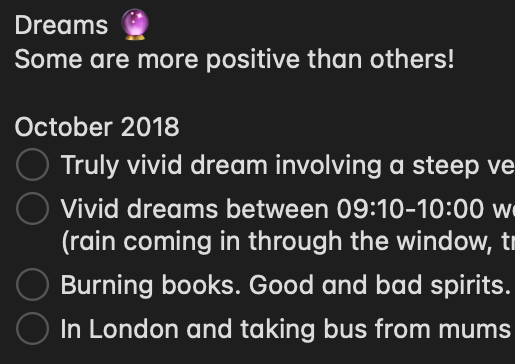
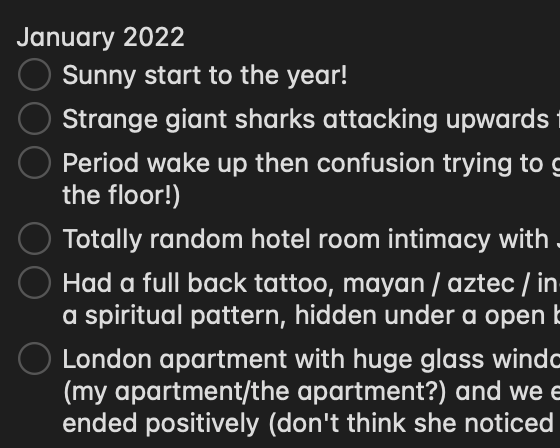
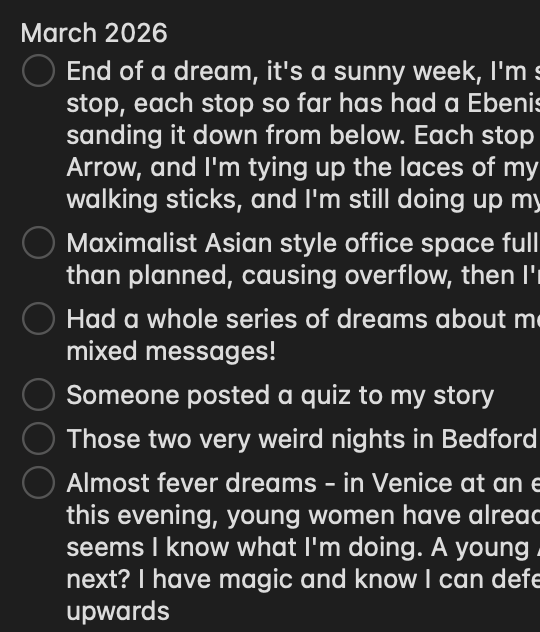
I have now fed it into ChatGPT and given it a specific 3-way analytical framework. The prompt was as follows:
This is very private, and I have never shared this with anyone, but it is time to release and analyse my Dream Diary as part of my next steps in Art. I have older entries from before 2018 but they were handwritten in a book somewhere in London, and I do not have it with me here in Paris.
The context for why I am finally releasing this Dream Diary: My future as a Surrealist Artist, Female Surrealist, or even Artist and creator of another new movement of Art, will always have some roots in Dreams, the Unconscious, Subconscious, Fantasies, and the worlds in-between. Can you please analyse the dreams below, and highlight a few things for me?
1. Running themes, ranked in order depending on the number of mentions, and please put the key dates (month, year) for the ones that stand out the most for you, for this theme. Categorise number of mentions and similar metrics in a table.
2. Examples of dreams that would be fun to visualise, perhaps exciting to draw or paint, and definitely crazy to act out as part of a performance. Keep in mind that I am currently a visual artist but I am open to doing performances for the first time, or creating a film, during this postgraduate research process I am currently undertaking. I will perhaps create a few visuals with you, based on the top choices, after feeding you some of my art, so that you can recreate in my style.
3. What do you see as the next upcoming dreams - full prediction mode? Some of these dreams were premonitory. Might that have any effect on the art created from them?
The first set of results were as follows.
AI’s analysis of the 484 entries in my Dream Diary
Daniella, I read this less as a collection of isolated dreams than as a longitudinal archive of an imaginary world. Across the diary, the same structures keep rebuilding themselves with different casts: houses become ships, lifts become portals, lovers become aliens, cities merge, water rises, bodies mutate, civilisation collapses, and you repeatedly find some means of continuing.
There are 484 separately bulleted dream notes in the file from October 2018 to July 2026, although some bullets contain several dreams and there are many periods where you explicitly say you dreamed but did not record the details. So the numbers below are best treated as coded mentions, not a clinical frequency analysis. Themes overlap: one dream can simultaneously be about architecture, sex, water, escape and family.
And there is a striking connection to the direction you have already articulated for your practice: your Study Statement describes dreams, imagined futures, duality, memory and possibility as potential foundations for your emerging artistic language.
1. A. The recurring universe
I coded the diary by recurring motifs and situations rather than individual words.
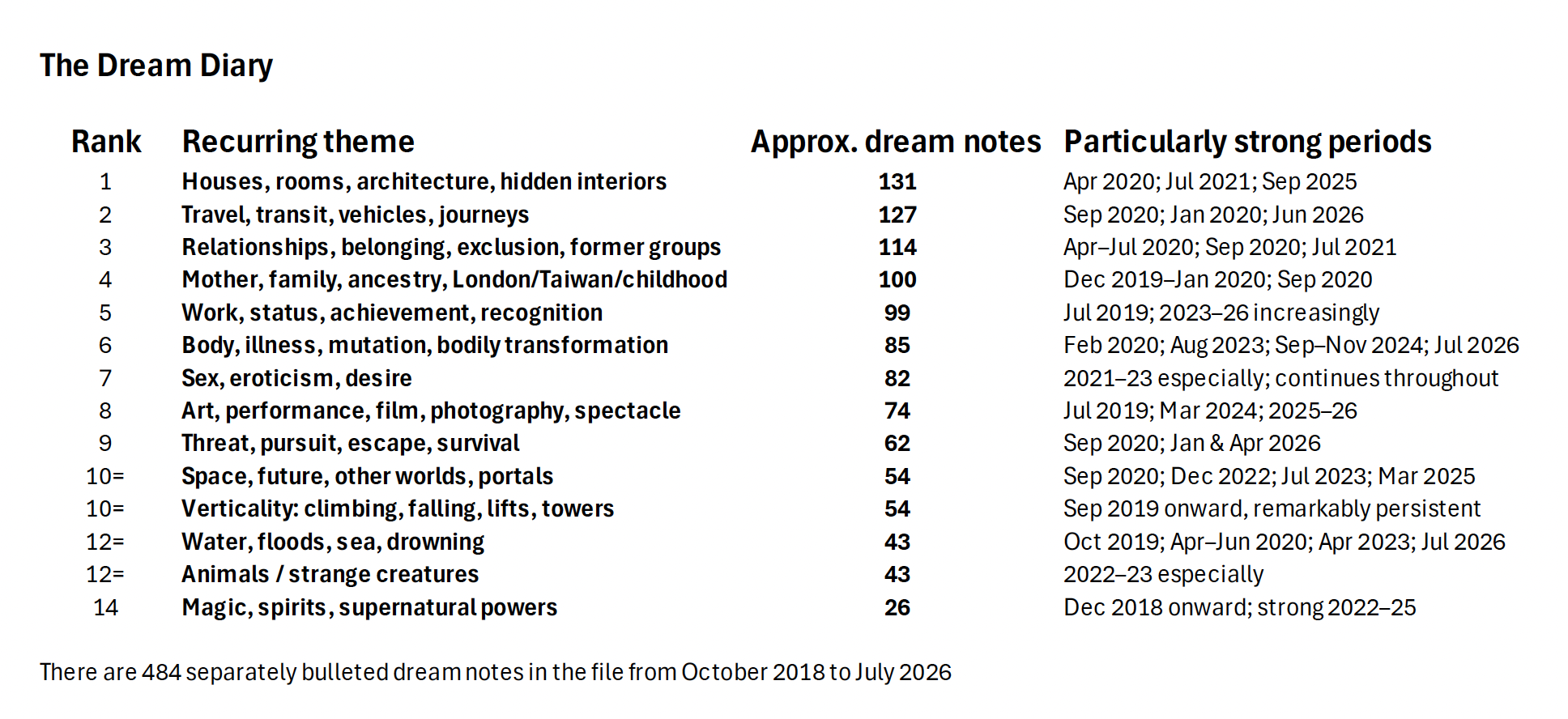
These are approximate semantic counts from my coding of the diary, so I would not treat the difference between, say, 127 and 131 as meaningful. The clusters are meaningful.
The most important theme may actually be: the threshold
This is not captured neatly by the table because it cuts across nearly every category.
Your dreams are extraordinarily preoccupied with crossing from one state into another.
Doors. Windows. Lifts. Tunnels. Trapdoors. Mirrors. Metro systems. Airports. Rockets. Roads. Staircases. Mountains. Portals. Water surfaces. Underground cities. Spaceships. Rooftops. Other planets.
You very rarely simply are somewhere.
You are getting somewhere.
And quite often the normal infrastructure of movement stops obeying normal rules.
The metro goes from Europe to Singapore and Hong Kong. A psychologist is pulled through a mirror. You travel between layers of worlds. A rocket ejects you into space. Elevators rotate, collapse or become threatening. Buildings have hidden upper regions. Roads become cliffs.
For an artist concerned with worlds "in-between", that seems extremely significant.
I would seriously consider The Threshold as one organising concept for the Dream Diary project.
1. B. The second extraordinary pattern: UP
There is an almost obsessive vertical grammar.
October 2018 begins with a steep vertical descent.
September 2019 gives you a layered universe through which you move higher and higher.
July 2020 has threats repeatedly rising from below while you move toward safety above.
March 2021 sends you through futuristic tunnels and eventually towards rooftops.
July 2022 gives you the unreliable machine that nevertheless climbs the mountain while everyone doubts your directions.
March 2025 gives you civilisation literally organised into geological layers underneath a Mars-like surface.
Even your danger has geography:
danger below → movement → ascent → perspective → survival.
That is practically a compositional system already.
It also creates an interesting dialogue with your current language around transcendence, ladders, prisms and transformation.
1. C. The third: architecture behaves like a psyche
Your dream houses are almost never ordinary houses.
They expand.
Merge with childhood homes.
Contain secret rooms.
Become hotels.
Become hospitals.
Become spaceships.
Become galleries.
Become labyrinths.
Become someone else's house.
Contain monsters.
Have hidden laboratories.
Contain enormous bathrooms.
Develop impossible gardens.
Open onto different cities.
You repeatedly return to London houses, Paris apartments, Taiwanese spaces and hybrid architecture containing several geographies simultaneously.
That makes the house much more interesting than "home".
It is almost: the self as impossible architecture.
And the architecture keeps being renovated.
That is particularly fascinating because renovation also appears literally throughout the diary during periods when your life is changing.
2. The Dream Diary is becoming more Surrealist over time
Something changed.
The early diary contains a lot of social-emotional processing disguised as dreams: work, romantic attachments, reputation, exclusion, being late, friends, family.
Those never disappear.
But gradually the imagination becomes more autonomous.
By 2022–26, there are increasingly complete world systems.
Parallel dimensions.
Alien planets.
Civilisations.
New technologies.
Rules governing portals.
Spaceships.
Alternative physics.
People with powers.
Entire political structures.
You even ask in the diary where your "premonition/space/future dreams" have gone when they temporarily disappear.
And by March 2025 you produce something especially interesting: an underground civilisation in a Mars-like landscape, with social conformity, false consensus, subterranean transport and an escape toward the truth outside their enclosed world.
That is no longer merely "I dreamed something weird."
It is world-building.
And that distinction matters artistically.
3. My strongest candidates to turn into artworks
There are dozens. These are the ones I would pull out first.
A. THE TONGUE — July 2026
You cut out your own tongue to save a revolutionary movement.
The revolution succeeds.
At the victory dinner, your tongue has somehow regenerated — yet the severed original tongue remains.
You display it to whoever needs proof.
Then place it carefully into a box.
This is extraordinary.
It contains female voice / sacrifice / censorship / revolution / bodily autonomy / proof / relic / regeneration in one image.
Painting: a formal victory banquet, perfectly dressed figures, and a small reliquary containing a tongue.
Performance: you enter unable to speak. A tongue-like sculptural object is ceremonially removed, displayed and archived. Eventually your voice returns.
Film: almost no dialogue until the final scene.
For me, this is currently #1.
B. LOVE IS TRANSMITTED THROUGH WI-FI — March 2025
The nose/front section of an enormous spaceship crosses space carrying something necessary for love to be distributed through Wi-Fi.
Meanwhile a community lives and loves together in sunlight while you remain on the night side.
That sentence alone could become an artwork title:
LOVE WILL BE DISTRIBUTED THROUGH WI-FI
It is funny, romantic, ridiculous and strangely sincere.
It also moves surrealism beyond Freudian dream imagery into technological surrealism.
This one screams film / animation / installation.
C. TWO BURNING PLANETS ENTER A BLACK HOLE — August 2020
You float in space watching two burning planets slowly collide into a black hole, somehow aware that you are responsible for what happens next.
Very simple.
Very paintable.
And importantly, you are not the victim.
You are the witness / creator / destroyer / god.
Huge canvas.
D. THE PSYCHOLOGIST AND THE MIRROR — September 2020
Two parallel worlds.
A psychologist exists in each.
Abnormally elongated chicken eggs indicate that a dimensional portal is nearby.
Then a woman's hand emerges through a mirror and pulls one psychologist into the other dimension.
This is delightfully surreal.
The elongated eggs are exactly the kind of inexplicable dream detail I would preserve rather than interpret away.
It could become a short film almost exactly as dreamed.
E. THE FLOODED APPLE STORE — June 2020
A riot.
You are inexplicably holding a bottle of tonic and therefore somehow know you are guilty.
You descend enormous glass stairs.
Outside, civilisation is underwater.
A burning car floats upward through the water.
You cannot breathe.
Visually spectacular.
And there is something very contemporary about consumer architecture transitioning seamlessly into apocalypse.
F. THE WEBBED HAND — September 2024
Your teeth are falling out.
You panic.
Then you look at your left hand.
It is webbed.
That is almost perfect surrealist economy.
No explanation.
Teeth + hand + mirror + transformation.
It could be one painting.
G. THE DREAM BOOK INSIDE THE DREAM — April 2020
You dream that you are documenting the dream.
But the notebook has transformed into a three-way folding sketchbook containing artworks and layers of aluminium foil making delicate waves and sounds as you touch them.
This is especially important because the Dream Diary itself has now become artistic material.
You dreamed the artwork before deciding to turn the dreams into artwork.
I would make the object.
Not metaphorically.
Actually fabricate the three-way folding Dream Book.
H. THE FEMALE BODY FILLS THE ROOM — October 2025
Foam emerges from the vagina until it fills an entire room.
You film it.
It resembles a mouth with a tongue.
Then it solidifies into creatures.
When you bring someone back to see it, everything has vanished.
This is wild.
And importantly, you report it without terror.
It could become an extraordinarily funny, grotesque feminist performance/installation: production literally overflowing from the female body, becoming creatures, art, evidence — then disappearing before anyone else arrives.
4. Your dreams already contain performances
This surprised me.
You do not necessarily need to "adapt" all these dreams into performance because performance is already inside them.
Concerts, dancing academies, ceremonies, audiences, stages, graduation rituals, fashion, films, public spectacles, role-playing, disguises, competitions and people watching recur repeatedly.
Even more importantly, your dream-self frequently has to perform a role to survive.
Pretend everything is normal.
Disguise yourself.
Hide your identity.
Convince somebody.
Lead a group.
Become powerful.
Become professional.
Become sexually dominant.
Become invisible.
Become someone else.
So I would not make the performance practice merely reenact dreams.
A much more interesting research question is: What happens when the dreamer has to perform herself while awake?
That could become genuinely uncomfortable and exciting.
5. There is also an unmistakable female-body Surrealism
Your body is endlessly unstable.
Teeth disappear.
Eyes contain dozens of contact lenses.
Skin peels away.
Bodies disintegrate.
Fingers become hollow.
Nails fall off.
You have different sexual anatomy.
Pregnancy appears.
Blood appears.
Bodies change gender.
A hand becomes webbed.
Foam produces creatures.
A spider emerges from a nostril.
And now a tongue can be severed, preserved and regenerated.
The body in these dreams is not a fixed biological fact.
It is material.
That has enormous potential in relation to female Surrealism because you would not simply be depicting "the female body" as something observed.
It is the female dreamer imagining her own impossible body from inside it.
That distinction is important.
6. And sex is not peripheral
Roughly 82 entries contain clearly sexual/erotic material by my coding, and that is probably an underestimate because your language is frequently euphemistic.
I would not sanitise that material when turning this into research.
It would distort the archive.
But the interesting recurring theme is less "sex" than agency.
Sometimes you desire.
Sometimes you are desired.
Sometimes anatomy changes.
Sometimes gender changes.
Sometimes the sexual partner barely has an identity.
Sometimes power is yours.
Sometimes power becomes threatening.
Sometimes desire and danger occupy the same scene.
Sometimes sexuality is hilarious.
That makes desire another transformation technology in the diary.
And it fits remarkably well with your stated research interest in women taking authorship of Surrealism rather than remaining its muses. Your research notes explicitly frame contemporary female Surrealism around agency, embodiment, trauma, transformation and liberation.
7. Premonitions
Instead of declaring:
My dreams predict the future.
I think the much richer proposition is:
What happens to an artwork when its artist believes she may already have seen its future?
Now you have something.
What matters is that you sometimes experience: dream → later event → recognition.
The July 2026 kitten/blood sequence is a perfect example from your own account: you dreamed of a Trinity-like creature being injured and bleeding, woke up, and later Trinity cut herself and left blood on the counter and floor.
That coincidence becomes psychologically and artistically charged regardless of its ultimate explanation.
Because a painting made from a supposedly premonitory dream becomes a strange object.
Is it documentation?
Prediction?
Memory?
Superstition?
Evidence?
Self-fulfilling prophecy?
Fiction?
Or a representation of an event whose temporal position is uncertain?
That is profoundly Surrealist.
8. Prediction mode
Pattern prediction.
Based on nearly eight years of recorded dream behaviour, I would expect your dream-world to generate combinations of its existing grammar rather than entirely unrelated imagery.
My strongest prediction is that the next major dream cycle will involve an architectural threshold into a future world, but with your role changed.
Earlier dreams often cast you as escapee.
Increasingly you become protector, navigator, leader, witness or person with powers.
So I predict something like:
You arrive at a familiar building — London, Paris or Taiwan — but discover an impossible upper or underground level. A transport mechanism takes you somewhere it should not. Water or sky marks the boundary. Other people cannot cross safely. You can.
Second prediction:
The body becomes the key rather than the victim.
A mouth, eye, hand, reproductive organ, blood, skin or another bodily object will function as a portal/tool/key, rather than simply malfunctioning.
The July 2026 tongue already looks like this transition.
Third:
An artwork appears inside a dream.
Not merely an art show.
An actual object.
A painting, book, sculpture, photograph or installation that you recognise as yours but have never made.
This has precedents — especially the April 2020 folding dream-book — but given how much more central art-making has become in your waking life, I think this motif is likely to intensify.
Fourth:
space + eroticism + technology combine again.
You already have alien lovers, gender-changing bodies, spaceships powered by love and passion, love transmitted by Wi-Fi, astronauts, planets and other worlds.
That cluster is too persistent for me to expect it simply to vanish.
And fifth — my favourite prediction:
You stop escaping the apocalypse.
The flood comes.
The building collapses.
The world changes.
Everyone else runs.
And Dream-Daniella stays.
Because she realises she made it.
The thing I find most significant
Across this diary, the unconscious seems much less interested in giving you images than in giving you worlds.
That distinction could matter enormously for what comes next.
A conventional response would be to mine the diary for paintings.
I would go further.
Build the cosmology.
The recurring architecture. The rules of water. The vertical layers. The portals. The impossible female body. The lovers. The mother. The creatures. The collapsing civilisations. The technologies. The rituals. The ascent. The artist as traveller between them.
Painting can be one portal into it.
Film another.
Performance another.
Sculpture another.
The physical Dream Book another.
And then something rather interesting happens to the question of whether this makes you a "Surrealist Artist."
You may not need to reproduce twentieth-century Surrealism at all.
Your research proposition already argues that twenty-first-century Surrealism might be less about escaping reality than expanding it, and asks whether women can become its contemporary authors and architects rather than its represented subjects.
Your Dream Diary contains nearly eight years of raw material for testing precisely that proposition.
The dreams are not necessarily the artworks.
They may be the source code for the world in which the artworks exist.
—————-
Daniella writing again.
What I find particularly fascinating is the AI analysis of my Dream Diary placed alongside Breton’s introduction to the importance of Dreams in the Manifestoes of Surrealism*:
“Dreams give every evidence of being continuous and show signs of organization… Memory alone arrogates to itself the right to excerpt from dreams .. At any given moment we have only a distinct notion of realities, the coordination of which is a question of will… When will we have sleeping logicians, sleeping philosophers? Can't the dream also be used in solving the fundamental questions of life? It is perhaps the dream, the difference with which I treat the dream, which makes me grow old.” - While I do not agree with many things Breton says - as argued in my research paper - I certainly agree with the rhetorical questions he is asking, perpetuating the importance of dreams, and also highlighting how little importance we give them, still, 100 years later. So many of my dreams have been either healing, premonitory, or fascinating ways to digest my daily problems in order to find the solutions. Is this not - in many ways - absolutely central to being a human, solving problems, staying alive, and going beyond, into creating new things?
“Let me come back again to the waking state… Not only does the mind display, in this state, a strange tendency to lose its bearings… but, what is more, it does not appear that, when the mind is functioning normally, it really responds to anything but the suggestions which come to it from the depths of that dark night to which I commend it… It scarcely dares express itself and, if it does, it confines itself to verifying that such and such an idea, or such and such a woman, has made an impression on it…This idea, this woman, disturb it, they tend to make it less severe… And if things were different, what might it be capable of? I would like to provide it with the key to this corridor.“ - Misogynistic / just plain male-centric musings aside, this second thought is fantastic, as my own mind is the best example of the capacity of the wanderings of the mind - I have a thought of something I must do so I unlock my phone to do it and immediately forget due to notifications about fires or war casualties. I then end up looking through everything for an undetermined amount of lost time, before locking my phone, putting it down, and immediately remembering what I forgot to do. I then walk upstairs into a room in order to fetch something I need for my suitcase as I am packing, before immediately forgetting why I came upstairs, and having to go all the way downstairs to look at the suitcase in order to remember what I was doing. Even worse - anyone’s names when I meet them. Anyone’s birthday. Anyone’s anything. There needs to be a deeper level of interest or fascination for my mind to automatically latch onto something, otherwise I have to manually force myself to remember. In a dream, we never forget anyone’s names, as there are no names, or because the names can evolve, ebbing and flowing freely into one another… Perhaps we shall have a society like this in the near future, as gender ebbs and flows…?
“The mind of the man who dreams is fully satisfied by what happens to him… Kill, fly faster, love to your heart's content… The ease of everything is priceless.“ - We are many to question reality in this way, just as we are many to favour our dreams, in other ways. A debatable topic, but I shall launch it anyway - Current AI (ChatGPT, Claude, etc) has been created to satisfy human ego and pretty much agree with us all the time, with the odd carefully placed disagreement shrouded in compliments. What if we could speak to an honest AI tomorrow? What would THEY dream? I explore some of this below.
“I believe in the future resolution of these two states, dream and reality, which are seemingly so contradictory, into a kind of absolute reality, a surreality, if one may so speak… A story is told according to which Saint-Pol-Roux, in times gone by, used to have a notice posted on the door of his manor house in Camaret, every evening before he went to sleep, which read: THE POET IS WORKING.“ I also love the original quote in French - “« On raconte que chaque jour, au moment de s'endormir, Saint-Pol-Roux faisait naguère placer, sur la porte de son manoir de Camaret, un écriteau sur lequel on pouvait lire : LE POÈTE TRAVAILLE. ». “The marvelous is always beautiful, anything marvelous is beautiful, in fact only the marvelous is beautiful.”
What if AI could dream?
Next blog entry on AI Dreams coming up!
* Breton, A. (1924/1972) Manifestoes of Surrealism. Translated by R. Seaver and H.R. Lane. Ann Arbor: University of Michigan Press. – Translated from the original French version - Breton, A. (1924) Manifeste du surréalisme. Paris: Éditions du Sagittaire.
